 Mecha-nudges for Machines

University of Chicago
News
-
Oct 2026
Accepted as a spotlight at NeurIPS 2026. We look forward to seeing you in Atlanta!
-
Jul 2026
We are providing compute microgrants for research on mecha-nudges: see the announcement on X for more info.
-
Jun 2026
Accepted as a poster at ACM EC 2026, and for a spotlight talk at the Game Theory and Mechanism Design with LLMs workshop.
-
Jun 2026
Accepted to the ICML 2026 TAIGR and AIWILD workshops, with an Outstanding Paper Award at TAIGR.
Abstract
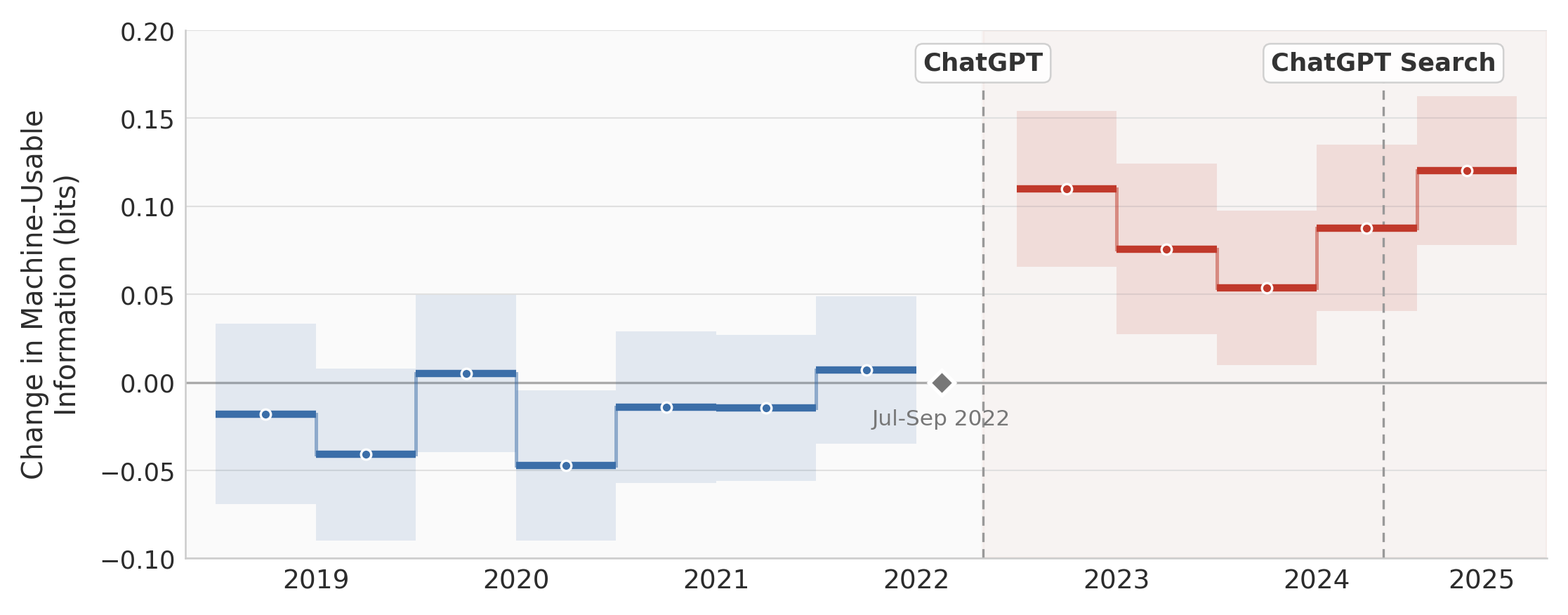
As AI agents make decisions in the same environments as humans, the environments themselves can change to influence them. We call this mecha-nudging: subtle changes to how choices are presented that systematically influence AI agents without materially degrading the decision environment for humans. It can arise from both intentional and unintentional adaptation to the rise of agents. To measure this phenomenon, we combine two frameworks—Bayesian persuasion from economics and V-usable information from computer science—to get a common unit (bits) for quantifying how environments change across a wide range of interventions, contexts, and models. Applying our framework to over six million product listings on Etsy—a global marketplace for independent sellers—we find that after ChatGPT’s release, listings contain significantly more machine-usable information about agentic curation, rising by over 40% of the maximum possible increase. This shift is robust across prompts, token choices, and models; absent in a regulated-text placebo; and cannot be explained by the rise of LLM-assisted writing. In contrast, a human study finds little to no change in human-usable information. Our results provide the first large-scale evidence that mecha-nudging is already happening in the wild, but going unnoticed.
Main result
Artifacts
Citation
@misc{mechanudges2026,
  title         = {Mecha-nudges for Machines},
  author        = {Giulio Frey and Kawin Ethayarajh},
  year          = {2026},
  eprint        = {2603.23433},
  archivePrefix = {arXiv},
  primaryClass  = {cs.AI}
}